If you’re planning a new home, especially a custom or luxury home in North Georgia, chances are you’ve already felt it: that low-grade anxiety humming in the background about cost.
You want something unique. Something tailored to your site, your lifestyle, your long-term plans. But you also don’t want the project to drift from “carefully planned” to “how did we get here?”
This concern is valid. New home construction costs have become harder to predict, materials fluctuate, labor availability changes, and many homeowners are walking into the process with budgets that feel more fragile than they used to.
The good news is this:
Reducing construction costs is not about cutting corners or settling for less. In my experience, it’s about making smarter decisions earlier, understanding where costs actually come from, and knowing where flexibility exists.
This article breaks down:
How to think about your home construction budget realistically
Five real, out-of-the-box ways I’ve seen clients successfully reduce costs
What to be careful of when trying to save money
And finally, answers to the most common questions I hear from clients starting their next build
Understanding Where New Home Construction Costs Really Come From
One of the biggest misconceptions around new home construction is that cost is primarily driven by square footage. While size matters, it’s rarely the whole story.
In North Georgia, especially on custom sites, costs are shaped by a combination of factors:
Site conditions like slope, access, soil, and drainage
Structural complexity rather than just size
The type of materials selected and how they’re sourced
How clearly the home is documented before construction begins
Custom home construction often involves non-standard solutions. Sloped sites, walk-out basements, large spans, and expansive glazing all add character, but they also introduce complexity. Complexity is not bad, but it needs to be intentional.
Where projects tend to run over budget isn’t usually due to one dramatic mistake. It’s the accumulation of small decisions made late, when changes are most expensive.
Most cost overruns aren’t surprises. It all traces back to a break down in communication.
How to Stick to Your Budget Without Killing the Design
The phrase “designing to a budget” gets used a lot, but it only works when the budget itself is grounded in reality.
A common pattern I see goes something like this:
A client designs their ideal home without seriously considering construction budgets at the same time
The design inspiration is often driven by Pinterest boards, Instagram saves, or one-off images taken out of context
Not taking the time to speak with their hired design team about their links between budget and their inspiration images.
At that point, the project often runs headfirst into reality.
The challenge with this approach isn’t the inspiration itself. Visual references can be incredibly helpful. The issue is that those images rarely show what actually drives cost: size, structure, site conditions, material availability, or the complexity hidden behind the finishes.
By the time pricing comes back, the design is already emotionally locked in. The home exists in the client’s mind as their house. When the numbers don’t align with the budget, the conversation quickly shifts from planning to compromise. Reducing cost starts to feel like stripping value, rather than making informed decisions.
This is where disappointment often enters the process. Not because the home is unaffordable in theory, but because the design and the construction budget were never developed together from the start.
A far healthier approach is to let inspiration, design intent, and budget evolve in parallel. When cost awareness is part of the design conversation early on, adjustments feel strategic rather than reactive, and expectations stay grounded long before construction begins.
Before design begins, it’s important to have the hard conversations about budget. Not as a constraint, but as a framework. Once a realistic home construction budget is established, priorities can be identified clearly. Is it space, views, materials, long-term durability, or a specific architectural moment? Not everything needs to be maximized, but the right things should be.
When those priorities are understood upfront, the designer can do what they do best: use experience to shape a concept that aligns with both the vision and the budget. Instead of designing blindly and adjusting later, the design is developed with construction realities in mind from the beginning.
That concept can then be presented to a builder as a guiding document, helping inform early pricing, scope, and feasibility before the project moves fully into construction. This approach keeps expectations aligned and avoids the cycle of redesign and disappointment that often comes from pricing a fully developed design too late.
Clear documentation also plays a critical role. Ambiguous drawings leave room for interpretation on site, and interpretation often leads to assumptions. Assumptions tend to show up later as change orders. Well-considered drawings don’t just communicate design intent, they help protect your budget by reducing uncertainty before construction begins.
Five Real, Out-of-the-Box Ways Clients Reduce Construction Costs
This is where experience really matters. Over years of working on custom and luxury home construction, I’ve seen clients successfully reduce costs in ways that aren’t obvious at first glance.
These aren’t theoretical ideas. These are strategies that have worked in real projects.
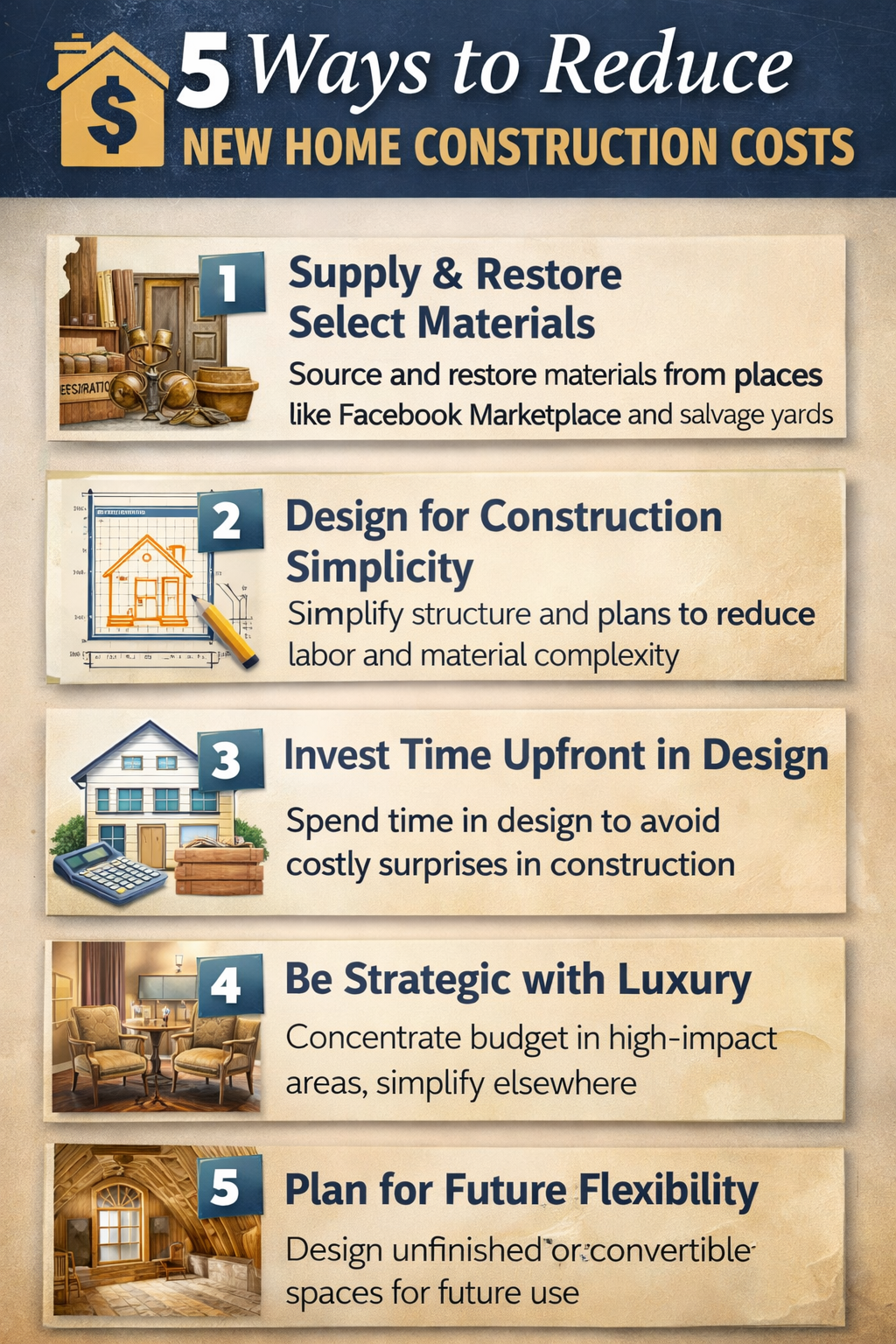
1. Supplying Select Home Construction Materials Yourself
One of the most effective cost-saving strategies I’ve seen is clients sourcing certain materials directly rather than through the contractor, and in some cases, restoring them themselves.
This often includes:
Windows and doors
Feature lighting
Plumbing fixtures
Architectural salvage and reclaimed elements
Clients who are patient and organised can find high-quality materials through:
Facebook Marketplace
Architectural salvage yards
Antique and reclamation shops
Direct suppliers
In several projects, clients have gone one step further by putting in a bit of sweat equity, restoring or refinishing salvaged items themselves. When done well, this can produce truly stunning results at a fraction of the cost of buying new. Beyond the financial benefit, it often adds depth and character that’s difficult to replicate with off-the-shelf products.
Why this works:
It avoids contractor markups on selected items
It allows materials to be sourced gradually rather than all at once
It often results in more character, not less
The key is coordination. These materials need to be selected early enough to be properly documented so builders can plan around lead times, dimensions, and installation requirements.
Client-Led Sub-Contractor Sourcing
Another lesser-known way clients have successfully reduced construction costs is by introducing alternative subcontractors to their builder.
On multiple occasions, I’ve had clients recommend subcontractors they’ve worked with previously or sourced independently. When those subcontractors are vetted and aligned with the project scope, this can create real savings without compromising quality.
Interestingly, this approach has often been a positive for the builder as well. In several cases, the contractor gained a new trusted subcontractor they could offer to future clients, expanding their own network rather than undermining it.
When handled collaboratively and transparently, client-led subcontractor sourcing can:
Introduce competitive pricing
Strengthen the builder’s long-term trade relationships
Keep the project moving without friction
As with material sourcing, this works best when approached as a partnership rather than a workaround. Clear communication, realistic expectations, and respect for the builder’s process are what make it successful.
2. Designing for Construction Simplicity, Not Just Size
Two homes of identical square footage can have vastly different construction costs.
Why? Complexity.
Highly articulated rooflines, irregular structural grids, and unnecessary framing gymnastics quietly drive up labor costs. These choices aren’t always visible in glossy renderings, but builders feel them immediately.
Thoughtful design can:
Simplify structure
Reduce framing labor
Improve build efficiency
This doesn’t mean bland architecture. Some of the most striking homes are also the most disciplined in how they’re put together.
Designing with construction in mind is one of the most powerful cost-control tools available in custom home construction.
3. Spending More Time in Design to Spend Less During Construction
This one feels counterintuitive, but it’s consistently true.
Projects that invest more time upfront in design and coordination almost always experience fewer surprises during construction.
In North Georgia, where sites are often sloped or wooded, early exploration through modeling and documentation can uncover issues before they’re expensive:
Retaining conditions
Structural transitions
Grading and access challenges
Every hour spent resolving these questions on paper saves many more hours on site. Construction is not the time to be figuring things out for the first time.
4. Being Strategic About Where Luxury Shows Up
Luxury doesn’t need to be everywhere to feel luxurious.
Some of the most cost-effective homes I’ve worked on concentrate budget where it has the most impact:
Primary living spaces
Key views and connections to the landscape
A few well-chosen materials used intentionally
Secondary spaces can be simpler without feeling compromised.
This approach allows clients to build a true luxury home without spreading the budget so thin that nothing feels special.
5. Designing for Future Flexibility Instead of Immediate Completion
Another smart strategy is designing spaces that can evolve over time.
Examples include:
Unfinished bonus rooms
Future additions planned structurally
Flexible spaces that can change use
Designing for flexibility upfront is far more cost-effective than retrofitting later. It allows clients to align construction costs with real timelines rather than forcing everything into phase one.
Things to Be Careful Of When Trying to Reduce Costs
Not all savings are real savings.
Some of the most common traps I see include:
Choosing the cheapest materials without considering longevity
Under-documenting the project to save design fees leading to expensive detailing and change orders later.
Not looking at contractor references and previous work
Keep in mind that cheap windows, vague drawings, and rushed decisions often cost more over time through maintenance, replacements, and change orders.
True cost control is about clarity, not shortcuts.
Final Thoughts: Cost Control Is a Design Skill
Reducing new home construction costs isn’t about saying no to good design. It’s about understanding consequences before they’re expensive.
When design decisions are made with intention, when materials are selected thoughtfully, and when the process is clear from the beginning, budgets tend to hold.
That’s not luck. That’s experience.
Frequently Asked Questions
1. Can I really reduce costs on a custom or luxury home?
Yes. Custom doesn’t mean uncontrolled. With smart planning and intentional decisions, custom homes can be both unique and financially disciplined. You’re hiring a skilled team to lead you through this process, taking into account to design wishes and style. Use them as much as you can to keep the project on track.
2. Does supplying my own home construction materials create risk?
It can if poorly coordinated, but when planned early and documented clearly, it often reduces cost and increases quality. Be sure to speak with your choosen contractor so they know what to expect from the build process. They will want to know what the materials are, where they are coming from and where they will be stored, what condition they are in and what end result you are looking to achieve. Keep in mind you are deferring some of the responsibility from the builder to yourself as they are no longer responsible for the condition of the materials before taking charge of them.
3. What design decisions most commonly blow the budget?
Late changes, unnecessary structural complexity, and vague documentation are the always costly to a project. One thing leads the rest when it comes to disruption and costs - poor communication.
4. Is it better to get a home construction quotation early or later?
It will be specific to your project. You will need a design to show a builder before they can give you numbers. I have never advised clients to ask builders for a ball park cost per square figure number before having anything to show for it, it leaves to many questions on the table and often doesn’t line up with the design later when they review the drawings. Talk the project through with your design team and any potential builders so everyone understands the framework of the project and then begin the design process with thisin mind.
5. When should I involve a designer to control costs?
As early as possible. Cost control starts with design decisions, not construction reactions. Most designers and builders are happy to meet with serious potential clients and discuss their projects dreams. Remember that individuals in our field get just as excited as you when it comes to design and building, that’s why we are here.